
The Employment Rights Act 2025 marks a pivotal moment in UK employment, reshaping rights for millions of workers and agency workers. Receiving Royal Assent on 18 December 2025, the Act introduces major changes to employment law, including statutory sick pay reforms, strengthened trade union rights, day one entitlements, and protections against fire and rehire. Most provisions come into force between April 2026 and October 2026, so employers and employees must prepare.
Building on the Employment Rights Act 1996 and other legislation, the ERA 2025 modernises terms and conditions of employment, addresses insecure work, and enhances safeguards against harassment or discrimination. The employment law changes included in the Act will take place over a period of two years, with the majority coming into effect in 2026 and 2027.
In this blog, we will explore what these changes are and what they mean for both employers and employees.
Why This Matters
The Employment Rights Act 2025 is widely seen as the biggest upgrade to UK employment rights in decades by broadening protections, modernising standards, and tackling insecure work. It touches everything from trade union law to parental rights, sick pay, redundancy protections, and more, affecting workers, employers, HR teams, and workplaces across sectors.
What’s Coming When
As the Act covers so much ground, its reforms are phased rather than coming into effect all at once.
Early 2026 Changes
Many key employment rights bill reforms will take effect in the first half of 2026 happening pretty much as the bill had been passed , changing everyday working rights
Repeal of the Strikes (Minimum Service Levels) Act 2023
The Strikes (Minimum Service Levels) Act 2023 will be abolished, removing the previous restrictions on industrial action.
Changes to the Trade Union Act 2016
Most provisions of the Trade Union Act 2016 will be eliminated, with some elements set to be repealed later through a commencement order.
Political Fund Ballots
Trade unions will no longer be required to conduct political fund ballots every ten years, simplifying administrative obligations.
Industrial Action and Ballot Notices
The rules around issuing industrial action notices and ballot notices will be streamlined, making the process more straightforward for unions and employers alike.
Enhanced Protections for Industrial Action
Workers will gain stronger safeguards, making it automatically unfair for an employer to dismiss someone for participating in lawful industrial action.
April 2026 Changes
Day-one Paternity and Parental Leave
From April 2026, workers gain day one entitlements for paternity leave and ordinary parental leave, allowing notices from their first day of employment. Bereavement leave, protections for pregnancy loss before 24 weeks, and enhanced maternity leave also come into force. Employers must update terms and conditions of employment and contracts of employment to reflect these rights.
Statutory Sick Pay (SSP)
From April 2026, statutory sick pay (SSP) undergoes significant reforms. SSP will be payable from the first day of illness, removing previous waiting days, and the lower earnings limit will no longer apply, meaning more workers, including zero hours and agency workers, will now qualify.
Employers will need to update hours contracts and employment contracts to reflect hours to be worked and SSP eligibility. The SSP rate will increase to £118.75 per week (up from £116.75), with an earnings threshold of £125 per week, and payments will be calculated as the lower of 80% of earnings or the flat rate, providing improved support for lower earners.
Whistleblowing protections
Under the new changes, whistleblowing protections will be broadened to explicitly include sexual harassment as a type of protected disclosure. This means that employees who report incidents of sexual harassment in the workplace can do so without fear of retaliation, ensuring stronger safeguards for vulnerable workers. By recognising these complaints as a protected form of whistleblowing, the law encourages a safer and more transparent work environment while holding employers accountable for addressing inappropriate behaviour.
Collective Redundancy Protective Award
From April 2026, the maximum protective award for employers who fail to consult properly during a collective redundancy will double from 90 days’ pay to 180 days’ pay. This change strengthens workers’ rights and encourages employers to follow the correct consultation procedures, helping to avoid costly employment tribunal claims.
Establishment of a new Fair Work Agency
A new regulatory body, the Fair Work Agency, is set to be launched in April, though the timeline for it to become fully operational remains uncertain. Once active, the agency will assume responsibility for several existing enforcement areas, including the minimum wage, the employment tribunal penalty scheme, labour exploitation and modern slavery, and regulations governing employment agencies.
Additionally, it will introduce a dedicated enforcement role for holiday pay and statutory sick pay, with expanded powers to impose higher penalties on employers who fail to provide the correct payments.
Joint and Several Liability Rules for Umbrella Companies
From April 2026, new Joint and Several Liability (JSL) rules will apply to labour supply chains involving umbrella companies. These changes are designed to tackle tax non-compliance and ensure that workers are paid correctly through PAYE.
Under the new rules, responsibility for unpaid PAYE tax and National Insurance will no longer sit solely with the umbrella company. Instead, HMRC may pursue other parties in the labour supply chain, such as recruitment agencies and, in some cases, the end client business, if an umbrella company fails to meet its tax obligations.
This represents a significant shift in accountability. Previously, umbrella companies were typically the primary party responsible for operating PAYE correctly. The new framework means that agencies and businesses engaging temporary workers must take greater care when selecting and working with umbrella providers.
For employers and agencies, this means:
Carrying out stronger due diligence on umbrella companies in their supply chain
Reviewing contracts and indemnity clauses with recruitment partners
Ensuring payroll arrangements operate fully under PAYE and National Insurance compliance
The aim of these changes is to reduce tax avoidance within the umbrella sector while increasing transparency and responsibility across labour supply chains.
Although the Joint and Several Liability rules are primarily focused on tax compliance, they align with the wider goals of the Employment Rights Act 2025, which seeks to improve worker protections and promote fairer working practices across the UK labour market.
Trade Union Processes
The operation of trade unions will be more streamlined are modernised. This means simpler recognition, electronic balloting making it more accessible for all.
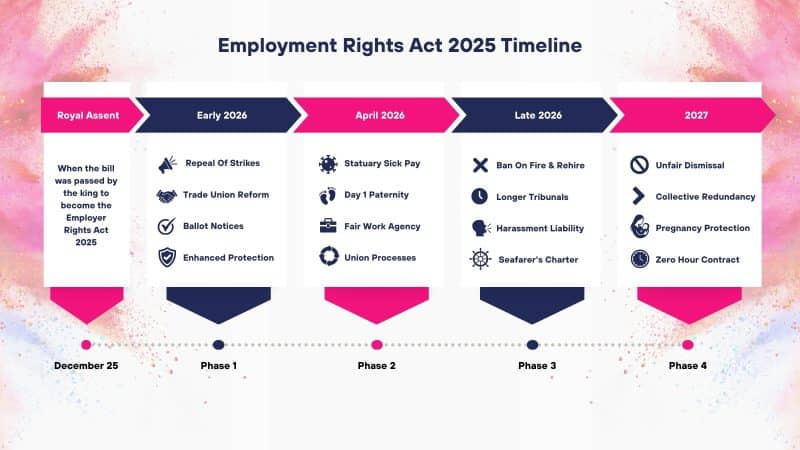
Late 2026 From October to December
Further important reforms are planned for late 2026.
Ban On Fire-and-rehire
Dismissing an employee and then rehiring them on worse terms and conditions will generally be considered automatically unfair. This means employers can no longer use this tactic to force workers into accepting reduced pay, fewer benefits, or less favourable working hours. The change is designed to protect employees from exploitative practices and ensures that any significant changes to contracts of employment are negotiated fairly, rather than imposed unilaterally. This will take immediate effect in October.
Employer Liability For Harassment
From October 2026, employers will be liable for harassment by third parties, such as customers or clients, unless they have taken all reasonable steps to prevent it. The law will also strengthen obligations around sexual harassment, requiring employers to take all reasonable steps, replacing the current “reasonable steps” standard. Additionally, changes to non-disclosure agreements (NDAs) are expected, which will make clauses invalid if they prevent employees from reporting or disclosing work-related harassment or discrimination. The exact date for this change has not yet been confirmed.
Extended Time Limits for Employment Tribunal Claims
The time limit for bringing most employment tribunal claims will increase from three months to six months. This change gives employees more time to consider their options, gather evidence, and seek advice before filing a claim. It applies to a wide range of disputes, including unfair dismissal, discrimination, and other employment rights breaches. For employers, this means a longer potential exposure period and a greater need to ensure contracts of employment, policies, and workplace practices are fully compliant with the new law to reduce the risk of employment tribunal claims.
Tipping Policies
From October 2026, employers will be required to consult with employees or their representatives before introducing a tipping policy. Additionally, tipping policies must be reviewed and updated at least every three years to ensure they remain fair and transparent.
Further Trade Union Reforms
From October 2026, several updates to trade union regulations will come into effect. Employers will have a duty to inform employees of their right to join a trade union. The rules governing a trade union’s access to the workplace will be modernised, and union representatives will gain new rights to reasonable facilities and accommodations to carry out their duties. Additionally, time off will be formally extended to union equality representatives to perform their responsibilities.
New Adult Social Care Negotiating Body
There will be a new negotiating body for adult social care will launch.
December 2026
Only one important change will happen in December.
Mandatory Seafarer’s Charter
There will be a new mandatory charter with enhanced standards for maritime workers comes into effect.
2027 Changes Including Unfair Dismissal & More!
While some reforms are phased in during 2026, others will come into effect in 2027. However, it is important to note that the timing of these changes is subject to government consultations.
Unfair Dismissal Protections
From 2027 the qualifying period for unfair dismissal rights will be reduced from 2 years to just 6 months. This means that employees can bring more claims earlier in their career.
Flexible Working Updates
the law around flexible working will be updated. If an employer refuses a flexible working request for a legitimate business reason, they will be required to provide a clear explanation for their decision and justify why the refusal is reasonable. While giving reasons is already considered good practice, it will now be a legal obligation, ensuring greater transparency and fairness in the handling of flexible working requests.
Collective Redundancy Consultations
A revamp in 2027 will happen again meaning the definition of “establishment” for the purposes of collective redundancy is set to change. This means that when assessing whether consultation obligations are triggered, employers may need to consider redundancies across the entire organisation rather than just at individual sites. The update is designed to ensure that employees are properly consulted and protected whenever large-scale workforce reductions are planned.
Protections For Pregnant Workers
Enhanced Protections for Pregnant Employees and Those Returning from Maternity Leave
Protections for employees who are pregnant or returning from maternity leave will be strengthened. Dismissals in these circumstances will generally be prohibited, except in very limited situations, such as genuine redundancy. The change ensures that vulnerable employees are better safeguarded against unfair treatment during critical stages of their employment.
Trade Unions
protections for trade union members will be extended to prevent discrimination or blacklisting, ensuring that employees are not penalised for union involvement. The year will also see the introduction of a new industrial relations framework, designed to promote collaboration between employers and trade unions and improve workplace dialogue on pay, conditions, and workforce matters.
Zero-hour Contracts
Workers who are on zero hour contracts will have the right to guaranteed hours if they want them.
Key Themes of the New Law
Across its many provisions, the Employment Rights Act 2025 is driven by several core priorities:
Fairness & Security
- Stronger safeguards against unfair dismissals and exploitative practices like fire-and-rehire.
- Support for workers in insecure or irregular jobs.
Modern Workplace Rights
- Day one rights for key family-friendly entitlements.
- Better sick pay and protections for vulnerable workers.
Union & Collective Empowerment
- Trade union reforms, easier strike ballots, and industrial action protections.
Enforcement & Compliance
- A dedicated Fair Work Agency to enforce rights and help ensure employers comply.
What Employers & Workers Should Do Now
With the phased rollout of these changes, preparation is essential:
For Employers:
- Review contracts, policies and procedures to ensure future compliance.
- Plan for SSP, leave, redundancy and dismissal process changes.
- Train HR and line managers on new obligations.
For Workers:
- Understand your expanded rights, especially around sick pay, leave and dismissal protections.
- Engage with your employer or union when changes are introduced.
- Stay informed as additional regulations and commencement orders are published.
How Mexa Solutions can help
Here at Mexa Solutions supports employers in updating contracts, policies, and workplace practices to comply with the Employment Rights Act 2025.
We also help employees understand their rights, including flexible working, trade union protections, and unfair dismissal safeguards, ensuring everyone is prepared for the upcoming changes. Learn more about how to navigate your career with our Practical Guide to Getting Hired
Final Takeaway
The Employment Rights Act 2025 marks a generational shift in UK employment law, with profound effects for workers and employers alike. While it became law in late 2025, the real impact begins in 2026, with a broad timetable of reform that will reshape workplace rights through 2027.
FAQs: Employment Rights Act 2025
What major changes to the law will the Employment Rights Act 2025 introduce?
The Act will introduce significant reforms to UK employment law, including day-one entitlements for parental leave, stronger protections against unfair dismissal and fire-and-rehire, improved statutory sick pay, expanded whistleblowing protections, and enhanced rights for trade union members. Many of these changes will come into effect between April and October 2026.
When do the key provisions of the Act come into force, and how should employers prepare?
Most provisions begin rolling out in 2026. Employers should develop an action plan to review and update employment contracts, policies, and HR procedures. Key areas to address include sick pay, parental leave, redundancy consultation, harassment policies, and trade union recognition processes.
What steps should employees take to understand their new rights?
Employees should review changes to parental leave, sick pay, unfair dismissal protections, trade union rights, and harassment safeguards. Engaging with unions, consulting HR, and staying informed about phased implementations in 2026 and 2027 will help ensure they can fully benefit from the new protections.
 This blog was written by Hollie Agombar, Senior Digital Marketing Executive at Mexa Solutions